How to Roll Cash-Secured Puts (and when to take assignment)
The stock has dropped and your short put is in the money. Everything you should do next hangs on one question, and it is not a question about the Greeks: would you buy this company here, today, at this strike?
The stock has fallen. The put you sold, which looked comfortably far away when you opened it, is now sitting at or below the money. The buyback quote has doubled. Your broker is showing a red number and the roll dialog is open in another tab.
Before you touch it, understand that the cash-secured put is unusual among options positions in that its worst-case outcome is one you volunteered for. You agreed to buy 100 shares at a price of your choosing and got paid for the promise. Whether the current situation is a problem or a Tuesday depends almost entirely on one question, and it is not a question about the Greeks.
Would you buy this stock here, today, at this strike?
Not "did you think it was a good idea a month ago." Now. With whatever you have learned since.
Everything downstream forks on the answer, and the two branches lead to completely different sets of moves. Traders get into trouble when they skip the question and reach straight for the roll button, because rolling is the one action that works reasonably well in one branch and terribly in the other, and it looks identical on the screen either way.
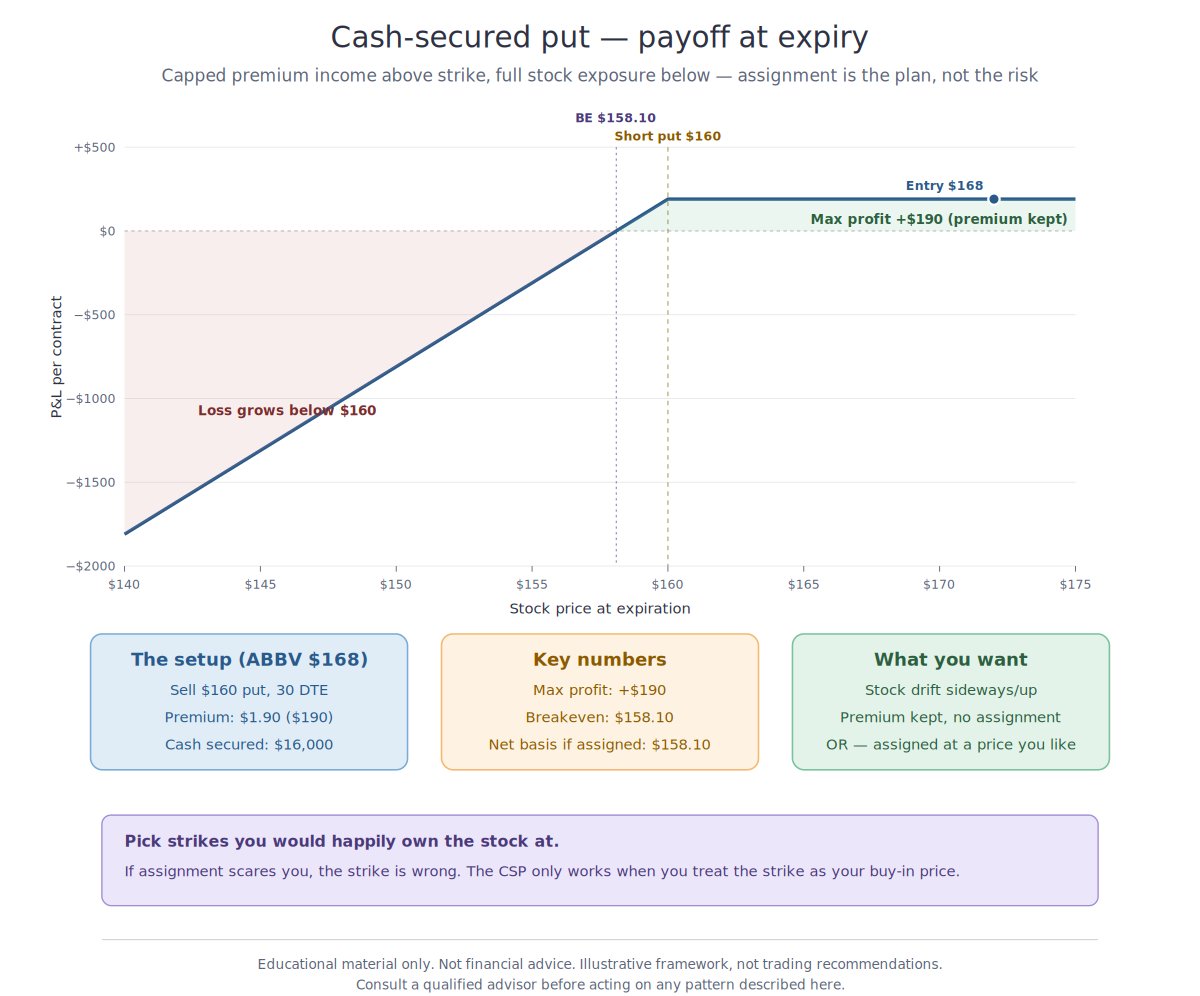
So, honestly: has anything actually broken? A company that missed guidance, cut a forecast, lost a major contract, or got hit with a regulatory problem is a different company than the one you underwrote. A company whose share price fell because its entire sector fell, or because the market had a bad fortnight, is the same company at a better price.
The distinction sounds obvious written down. It is much harder at the screen, when the red number is doing the arguing for you.
If you still want the shares
Then this position is behaving normally and you have two reasonable moves.
Take the shares
Let it get assigned. You buy at the strike, less the premium you already collected, which is exactly the deal you signed. This is not a defeat, it is the second half of a wheel. Your basis is lower than anyone who bought the stock outright on the day you opened the trade, and you can begin selling calls against the position immediately.
Doing nothing is a real choice here and it is very often the correct one. It also happens to be the cheapest, which is worth noticing given the alternatives all cost something.
Roll down and out, but only for a credit
The other move is to buy back the put you are short and sell a lower-strike put in a later cycle. Done properly this lowers the price at which you will eventually be buying the stock, and pays you a small amount for the trouble.
The test is the same as it is anywhere else in options. Price the buyback, price the new put, and subtract. Positive means the roll collects a credit, your future entry price improves, and the extra time you have committed is being compensated. Negative means you are paying cash to postpone a decision, which is usually a slower way of arriving at the same place with less money.
There is a constraint here that most articles skip, and it is the single most useful thing to understand about rolling a short put. You cannot move the strike down without moving the expiry out, and the further down you want to go, the further out you have to go to pay for it. A lower strike is worth less premium. The only place that lost premium can come back from is time. This is not a broker limitation or a market inefficiency, it is just what the option is worth, and no amount of hunting through the chain will produce a version where you get a meaningfully lower strike, a fat credit, and a near expiry all at once.
The roll pays a net credit, and the new lower strike is a price you would be pleased to own the stock at. One without the other is not an adjustment, it is a delay.
Working the arithmetic
Illustrative numbers, but priced rather than invented, so you can check them against a chain.
With WFC at $78 you sold the $72 put, 45 days out, and collected $1.10. Entry delta was 0.21, implied vol around 32%, and you set aside $7,200 of collateral. You were content to own the bank at $72.
Two weeks pass. A regional lender stumbles, the sector sells off in sympathy, and WFC trades at $71. Nothing has changed at the company itself. Your put is now marked at $3.55, delta has climbed to 0.51, implied vol has expanded to 38%, and 31 days remain.
The thesis holds, so both moves are open. First, the honest menu of rolls, priced against that $3.55 buyback.
| Roll to | Sell for | Net | What you actually got |
|---|---|---|---|
| $72 put, 66 DTE | $4.80 | +$1.25 | The fattest credit, and no strike improvement at all. |
| $70 put, 66 DTE | $3.78 | +$0.23 | Down $2. The credit is thin but it is a credit. |
| $70 put, 94 DTE | $4.53 | +$0.98 | Down $2 and paid properly, but three months of capital. |
| $68 put, 66 DTE | $2.90 | −$0.65 | Down $4 too fast. This is a debit. Do not do it. |
| $68 put, 94 DTE | $3.63 | +$0.08 | Down $4 is available, but only if you buy it with time. |
Read that table twice, because it is the whole argument. Every dollar of strike improvement has to be paid for, in credit or in duration, and there is no row where you get both. The trader who talks about "just rolling down and out for a credit" as though it were a lever you pull has usually not priced it.
Take the $70 at 66 days. Down two dollars, twenty-three cents in the pocket. Now here is what it does to your position.
| Do nothing | Roll to $70, 66 DTE | |
|---|---|---|
| Premium already collected | +$1.10 | +$1.10 |
| Buy back the $72 put | — | −$3.55 |
| Sell the $70 put | — | +$3.78 |
| Net premium banked | +$1.10 | +$1.33 |
| Strike you would buy at | $72.00 | $70.00 |
| Effective cost if assigned | $70.90 | $68.67 |
| Collateral | $7,200 for 31 more days | $7,000 for 66 more days |
The roll clears the credit test, barely, and it drops your eventual purchase price by $2.23 per share. On 100 shares that is $223 of improvement on a trade that also paid you twenty-three cents to make it. Modest, but real, and pointed in the right direction.
Now the part the table flatters. If WFC steadies and recovers to $78, the version where you did nothing releases $7,200 of collateral in 31 days with $110 of profit and no stock. The version where you rolled keeps $7,000 tied up for 66 days to bank $133. You spent 35 extra days of capital to earn an extra $23 and a lower strike you never needed.
Which is the honest description of what a roll down and out actually is. It is not a repair, and it is not "avoiding a loss." It is buying a better entry price with time, on a stock you have already decided you want to own. If the decline continues, you will be glad you paid. If it does not, you paid for insurance that expired unused, which is what insurance usually does.
If you no longer want the shares
Different situation entirely, and the moves that were sensible above become actively harmful here.
The mistake to avoid is rolling. It feels like the responsible thing, because you are collecting premium and lowering the strike and it all has the texture of taking action. But you are extending a commitment to buy something you have concluded you do not want, and you are doing it in exchange for pocket change, and you will very likely be back here again next month with a lower strike and the same problem.
The clean exit is to buy the put back and take the loss. Paying $3.55 to close a put you sold for $1.10 is not enjoyable, but it is a known, bounded $245 per contract, and it hands you back $7,200 of collateral to deploy somewhere you actually believe in. That comparison, a defined loss today against an open-ended commitment to a business you have lost faith in, is not close.
The variation worth knowing is that if you genuinely think the stock has much further to fall, you can close the put and put on a bearish position instead. This is a distinct trade with a distinct thesis, not a repair of the old one, and it should be sized and justified on its own terms. Do not let it smuggle itself in under the heading of "adjustment."
Why short puts get expensive so quickly
A thing that surprises newer sellers: the put you sold for $1.10 did not become worth $2.00 when the stock fell 9%. It became worth $3.55. Most of that extra is not the stock price at all.
Take the WFC position apart and you can see exactly where the damage came from.
| Step | Put is worth | Because |
|---|---|---|
| You sold it | $1.10 | WFC at $78, delta 0.21, vol 32% |
| What delta alone predicts | $2.57 | 0.21 × the $7 drop, added to your entry price |
| Actual reprice, vol unchanged | $3.03 | Gamma. Delta itself climbed from 0.21 toward 0.51 on the way down. |
| Actual reprice, vol at 38% | $3.55 | Vega. The market repriced the fear, not just the stock. |
Delta accounts for $1.47 of the move. Gamma adds another $0.46. Vega adds $0.49 on top, and that last piece is pure sentiment. The company did nothing. The market simply decided that a wider range of bad outcomes was now plausible, and you were short that opinion.
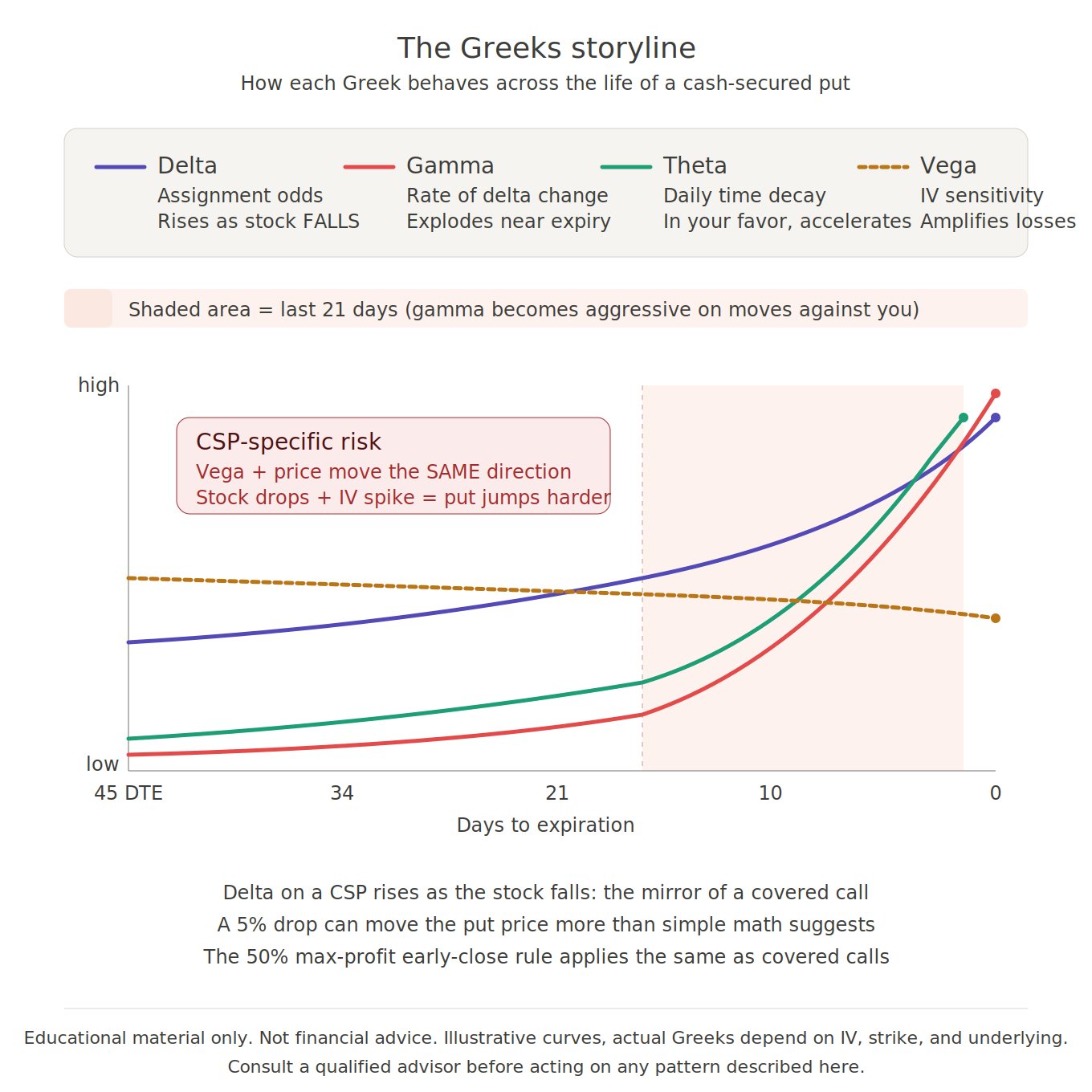
Delta is the market's running estimate of whether you end up with the shares. It starts around a quarter and climbs as the stock approaches your strike. Past about half, assignment has become the base case rather than the tail case.
Gamma is what makes delta itself unstable, and it is at its worst when expiry is close and the stock is loitering right at the strike. This is why a position that felt manageable with a month to run can feel completely different with ten days left, having done nothing more dramatic than sit still.
Theta is your income and it is your friend. Every day that passes without incident puts money in your pocket, and it puts more of it in during the back half of the trade than the front half. This is why closing at half of maximum profit is a habit worth having. You take most of what the trade was going to give you and you leave before the last stretch, where the odds get lumpy.
Vega is where the surprise lives. When a stock sells off, implied volatility on its puts does not sit politely still. It expands, because the market is now pricing a wider range of bad outcomes, and you are short that volatility. So the put you sold gets repriced for the drop and repriced for the fear about the next drop.
Falling stock, shrinking clock, and expanding volatility do not politely take turns. They pile in together, which is why the exit that looked expensive on Monday can look extortionate by Thursday. The consolation is that stocks rarely fall out of a clear sky. There is usually visible deterioration for several sessions before the option price catches up, and the traders who get out cleanly are the ones who acted during that window rather than after it.
The same paragraphs, without the jargon
Delta is roughly the chance you end up buying the shares. Small when you open, larger as the stock comes toward you.
Gamma is how fast that chance changes. It is calm when expiry is far away and jumpy when it is close, which is the argument for deciding early.
Theta is the money you earn simply by waiting, and it is the entire reason anyone sells a put in the first place.
Vega is the extra cost that shows up because the market got scared, on top of whatever the stock actually did. It is why buying back a put after a selloff costs more than the price move alone would explain.
The short version: when a stock drops, your put gets more expensive for two reasons at once, and waiting a few more days tends to add a third. If you are going to act, act while the numbers are still reasonable.
The failure mode that catches most people
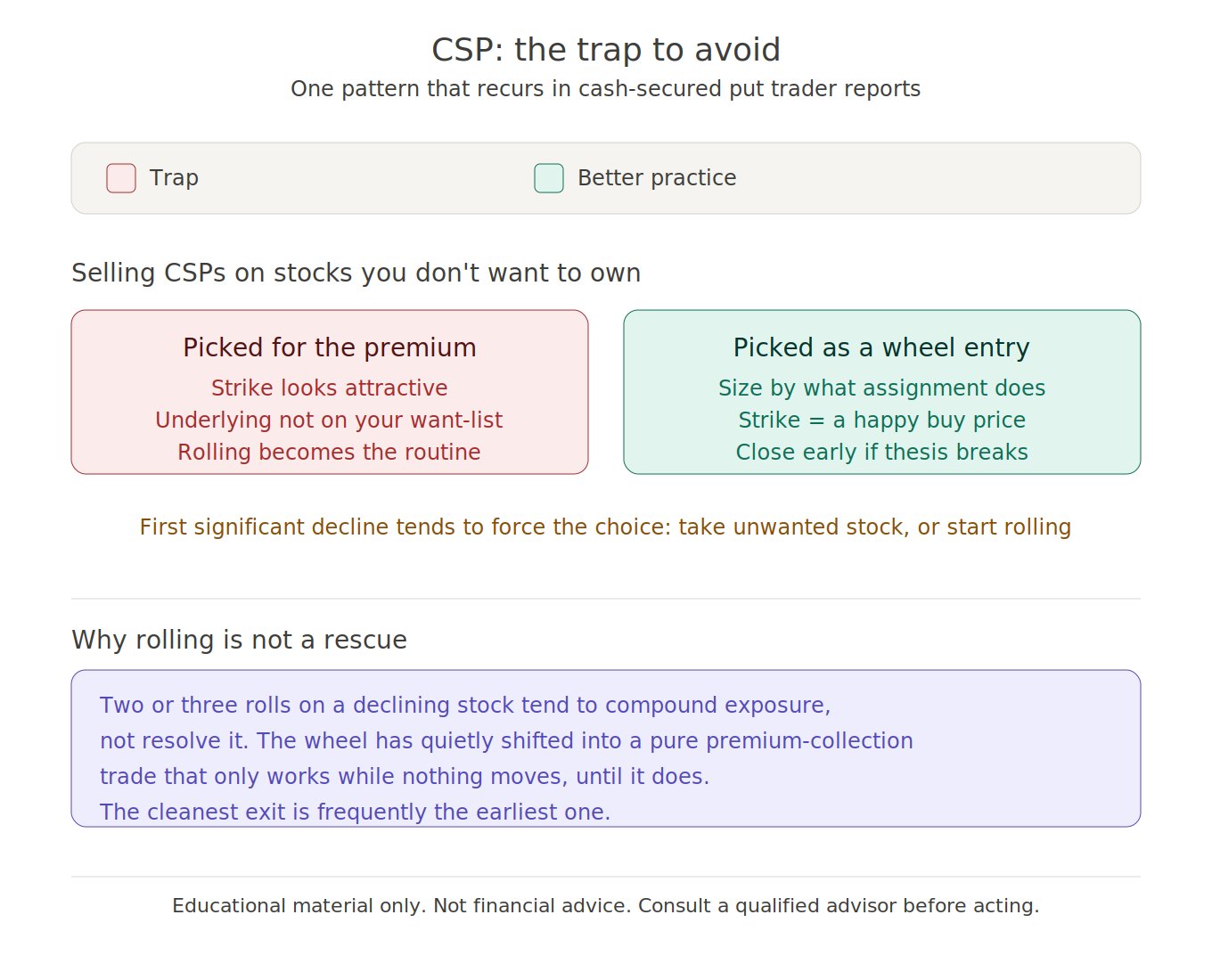
Every bad cash-secured put story begins the same way. The premium looked generous. The yield in the screener was eye-catching. The trader did not look too closely at why the market was paying so well to insure that particular stock, and sold the put anyway.
The market was paying well because the market was worried, and often the market was right. So the stock falls, and now the trader is holding an obligation to buy something they never wanted, at a price that no longer looks clever. Assignment is unacceptable, so they roll. The stock keeps falling, so they roll again. Each roll collects a little cash and buys a little time, and the position quietly becomes a permanent tenant in the account, consuming collateral and attention that could have gone somewhere useful.
The prevention costs nothing and happens before the trade exists. Ask whether you would be happy to own 100 shares of this company at this strike for the next year. If the answer is anything other than yes, the premium is not compensation, it is bait.
The decision as a flowchart
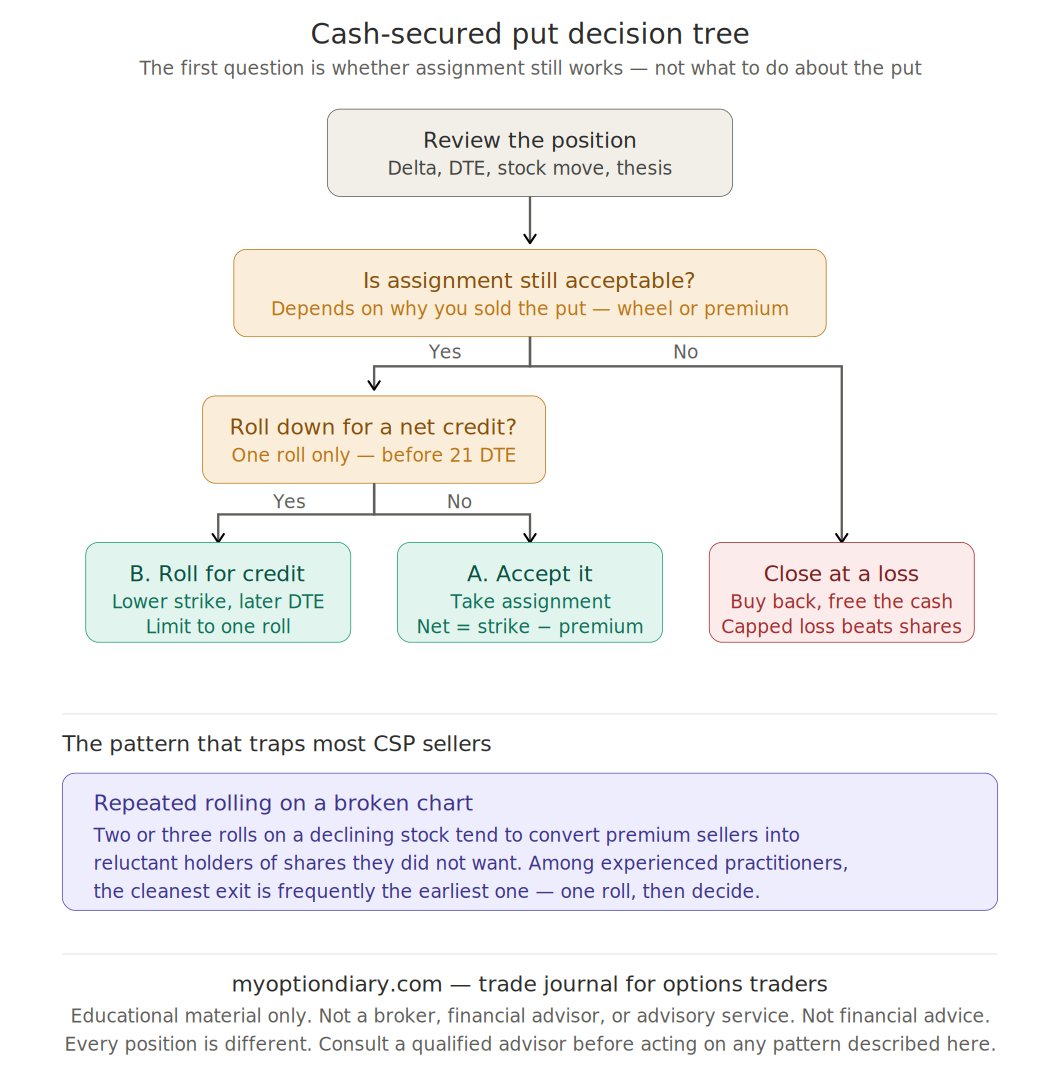
The chart below is the whole article compressed. It starts at the only question that matters and works outward from there.
If you read nothing else
A cash-secured put that is in the money is not automatically a problem. It is the position doing the thing you were paid for. Ask whether you still want the shares at the strike, and let that answer drive everything.
Yes means assignment is fine and a credit roll to a lower strike is optional rather than urgent. No means the roll is a trap and closing the position, at a real and bounded loss, is the move that gets your capital and your attention back. What you should not do is roll on autopilot, because it is the one action that feels productive in both cases and is only helpful in one of them.
Your CSP cycle, tracked end-to-end without the spreadsheet
MyOptionDiary tracks the cash-secured put through every step of its cycle — entry validation, the amber alert when the stock weakens past the threshold, four live roll scenarios when adjustment is on the table, automatic lot creation on assignment with the premium folded into your cost basis, and the next covered call written against the same lot. No CSV re-imports between steps. The decisions in this article are the same. The math is just already on the screen.
Disclaimer. MyOptionDiary is a trade recording journal — a personal record-keeping and educational tool. It is not a trading advisory, broker, financial advisor, or investment platform, and does not provide any form of financial advice or trading recommendations.
This article describes adjustment scenarios and practitioner patterns observed among options traders. It is educational material. Every position, account, and market condition is different; no single approach is universally correct. Outcomes described in worked examples are illustrative — actual results will vary.
Before making any adjustment to a live position, consider your own risk tolerance, capital, and tax situation, and consult a qualified financial advisor if you are uncertain. To the maximum extent permitted by law, MyOptionDiary and its author shall not be liable for any trading losses, financial losses, missed opportunities, tax consequences, or any direct, indirect, incidental, or consequential damages arising from your use of this article or reliance on any information, scenario, or pattern described herein. You are solely responsible for your own trading decisions and their outcomes.