How to Roll Covered Calls for Credit (and when not to)
Your covered call went through the strike and none of the rolls look good. Before you click anything, there is one piece of arithmetic that decides the whole question, and it takes about forty seconds.
You are probably here because a covered call has gone against you in the good way. The stock ran. The call you sold is now in the money, the quote to buy it back has doubled or worse, and none of the roll choices on your screen look like the clean fix you were hoping for. Every extra session seems to make the numbers uglier.
Most guides answer this by telling you to roll up and out for a credit, as though that were always available. It is not. Whether a roll is even a sensible trade depends on arithmetic the option chain will do for you in about forty seconds, and quite often that arithmetic says the roll is a bad idea and the position is fine. This article puts the math first, works a real case where rolling is the wrong answer, then explains why the calendar matters more than the chart when you are deciding what to do.
Answer this before you touch the chain
Would you actually be unhappy if the shares went away at your strike?
Sit with that for a second, because a surprising number of adjustments get made by traders who never asked it. If the strike is above your cost basis and the combined return on premium plus share appreciation is a number you would have happily signed up for on the day you opened the trade, then nothing has gone wrong. The position did exactly what it was built to do. Assignment is the exit it was designed around, not a failure state.
The reason this gets skipped is psychological rather than financial. Watching a stock run past your cap feels like leaving money behind, and doing nothing feels passive. But rolling to chase a stock that has already moved usually means paying for the privilege of taking on more risk at a worse entry, which is a strange thing to do in response to a winning trade.
If the honest answer is that you do not want to lose the shares, or the strike sits below your basis, then keep reading. The rest of this is for you.
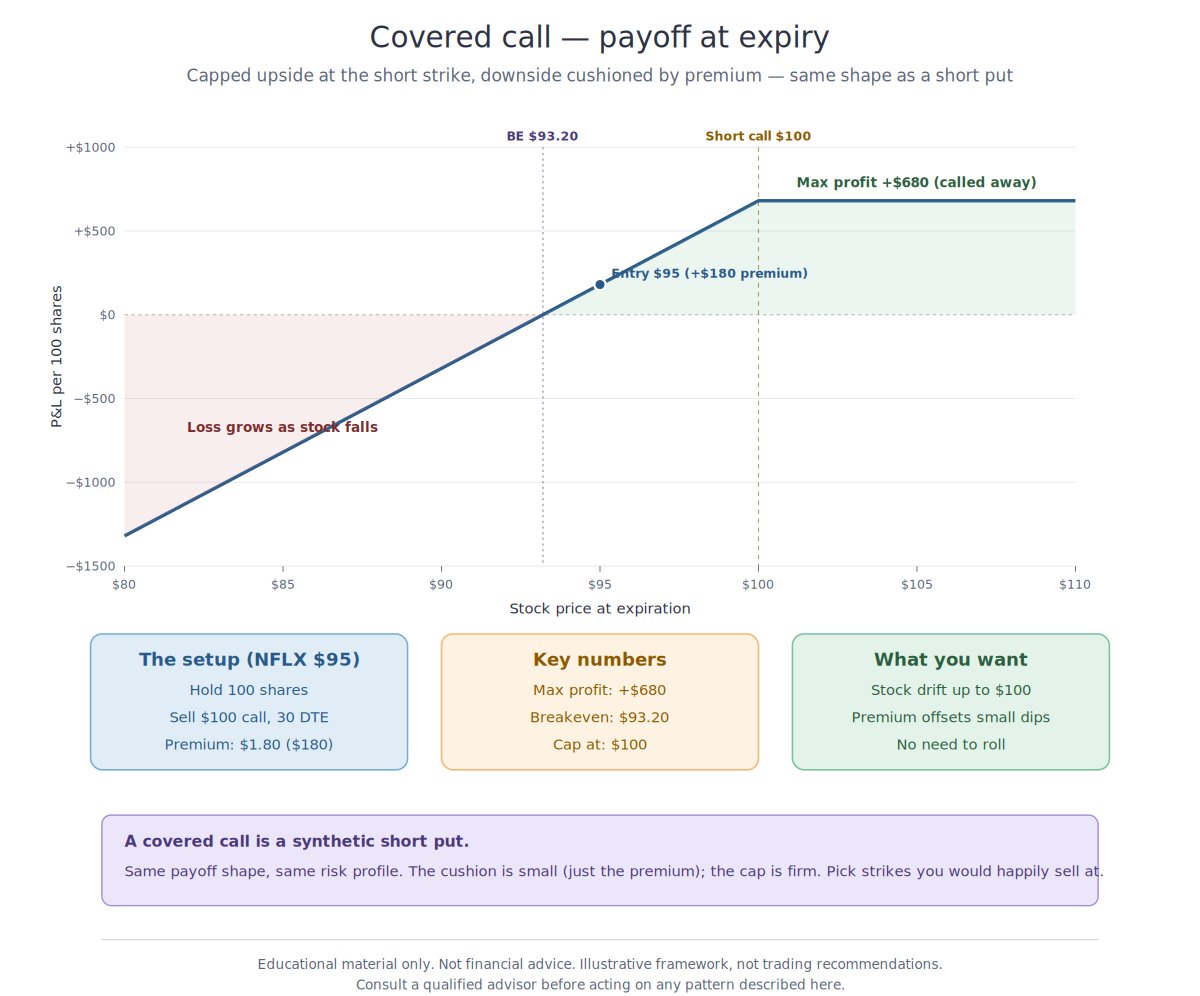
The credit test
Here is the whole decision in one line: a roll is worth taking when the market pays you to move your cap higher. It is not worth taking when you have to pay the market for the same favour.
Concretely, price two things.
- What it costs to buy back the call you are short.
- What you receive for selling a call at a higher strike, in a later cycle.
Subtract the first from the second. If the result is positive, you have collected a net credit, you have raised the ceiling on the position, and the extra time you have committed is being paid for. That is a roll worth doing.
If the result is negative, stop. A net debit roll means you are handing over cash today to keep a position alive that has already hit its designed exit, and you are extending your exposure to do it. There are narrow cases where that makes sense, mostly involving tax timing or a very specific view on the next leg up, but they are rare and you should be able to state the reason out loud before you click.
Net credit positive, the roll is live. Net credit negative, the roll is a purchase, and you should be able to say what you are buying.
There is a second condition people forget. Even a credit roll can be a poor trade if the new strike is not somewhere you would genuinely be happy to sell. Collecting a small credit to move your cap from $50 to $52 when the stock already changes hands at $54 is not raising your ceiling. It is locking in a sale below the current price and calling it an adjustment.
A worked example where the roll fails
Numbers below are illustrative but they are priced, not invented. Everything is marked at roughly 45% implied volatility, which is an ordinary level for a semiconductor name, so you can check the arithmetic against a chain yourself.
You own 100 shares of MU at a cost basis of $118. With the stock at $126 you sold the $140 call, 38 days out, for $2.80. That is an 11% cushion to the cap and a delta of 0.27, which is a perfectly ordinary place to open a covered call.
Three weeks later the company guides higher and the stock is at $148. Your call is bid at $10.65. Delta is 0.74. There are 17 days left.
| Leg | At entry | Now | Change |
|---|---|---|---|
| 100 shares | $118.00 basis | $148.00 | +$30.00 |
| Short $140 call | sold at $2.80 | $10.65 | −$7.85 |
| Net per share | +$22.15 |
The call shows a $785 paper loss and that is the number your eye goes to. Ignore it. The position as a whole is up $2,215, and the only question that matters is what happens next.
Now run the credit test against the actual chain.
| Proposed roll | Buy back | Sell | Net | Verdict |
|---|---|---|---|---|
| $150, next cycle (45 DTE) | −$10.65 | +$8.78 | −$1.87 | Debit. Fails. |
| $145, next cycle (45 DTE) | −$10.65 | +$11.23 | +$0.58 | A credit, but the cap sits $3 below spot. |
| $155, two cycles out (80 DTE) | −$10.65 | +$10.09 | −$0.56 | Debit, and 80 more days committed. |
There is no clean roll here. The only structure that pays you a credit sets your ceiling at $145 while the stock already changes hands at $148. That is not a cap, it is a guaranteed sale at a discount, and the 58 cents is the market charging you for the privilege of noticing. Everything else needs you to write a cheque.
So what is the right move? Do nothing. Let the shares go at $140.
Sold at the strike you receive $140, plus the $2.80 you already banked, against a basis of $118. That is $24.80 per share, or $2,480 on the position.
One caution on how you read that number, because the low basis flatters it. Of the $24.80, the covered call campaign is responsible for $16.80: the $2.80 of premium plus the $14.00 of share appreciation between $126 and the $140 cap. Measured against the $126 the stock was worth on the day you wrote the call, over 38 days, that is 13.3%. The other $8.00 was gain you were already sitting on and would have collected whether or not you had ever sold an option. Both numbers are real. Only one of them belongs to the covered call, and traders who conflate the two end up with a wildly inflated sense of what premium selling actually earns them.
When the chain refuses to pay you a credit to roll, that is information. It is usually telling you the stock has moved far enough that your original cap is now the good outcome, and the market has no interest in giving you a better one for free.
Why the calendar decides more than the chart
The same position can be easy to fix at 35 days and impossible at 7. Nothing about the stock changed. What changed is which forces are acting on the option price, and that is worth understanding because it tells you when to make the call, which turns out to matter more than what you decide.
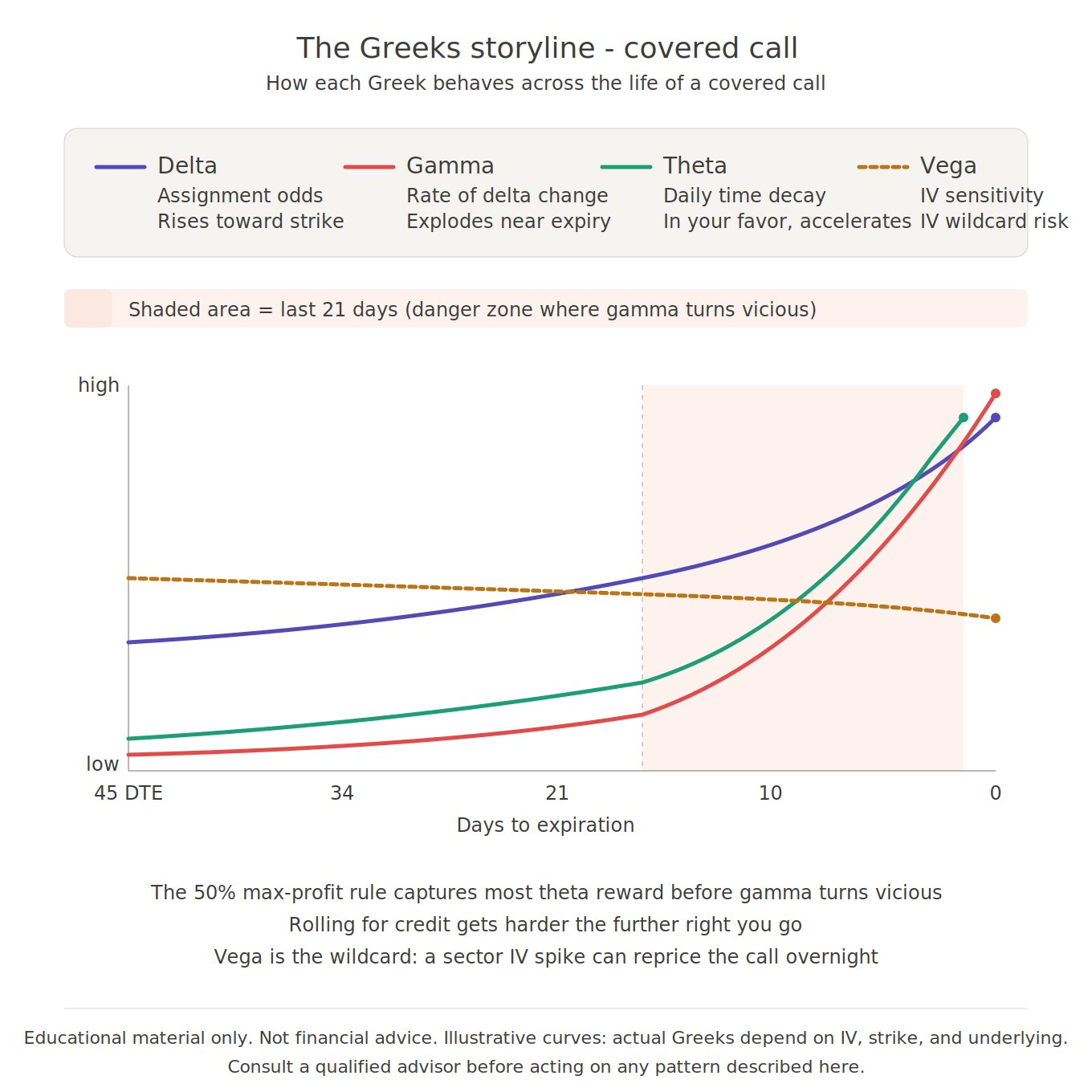
Delta tells you the odds, and it moves. Open a covered call somewhere around 0.25 to 0.30, and the market is telling you it likes the call's chances of expiring worthless. Once delta pushes past 0.45 the market has changed its mind and now favours assignment. Somewhere past 0.70 your short call starts tracking the stock almost one for one, at which point the shares and the call are largely cancelling each other out on every further move up. This is the first number to look at, not the last.
Gamma is why the last three weeks are different. Gamma measures how quickly delta itself changes. Far from expiry it is small and the position behaves predictably from one day to the next. Close to expiry, with the stock loitering near your strike, gamma is large enough that delta can travel from 0.30 to 0.70 in a single session. That is the mechanism behind the familiar story where a trader is comfortable on Friday, the stock gaps 3% on Monday, and the cost to close has tripled before they have had coffee. The stock did not do anything unusual. The clock did.
Theta is the reason the trade exists, and it is not evenly spread. Time decay works for you every day you stay short the call, but it does not arrive at a constant rate. Most of a 45-day option's time value evaporates in the back half, with the final week producing the largest daily numbers. That is the case for the well-worn habit of closing at 50% of max profit. You collect the bulk of the reward and you step off the field before gamma turns the last stretch into a coin toss.
Vega is small here, but it points the wrong way. Being short a call means being short volatility. If implied vol rises, the call gets more expensive to buy back even when the stock has not budged. The version of this that catches people out is entirely secondhand: you sell a call on a quiet name, nothing happens, then a competitor reports earnings, sector volatility jumps, and suddenly your buyback costs 25% more for no reason connected to your stock at all.
They arrive together. That is the part worth sitting with. Delta climbing through the strike, gamma sharpening because expiry is close, and vol expanding because something is on the calendar are not three separate problems. They tend to show up as one, and when they do the option price moves faster than any linear estimate suggests. That is the state in which the roll credit has already evaporated, closing crystallises an ugly number, and waiting makes it worse. Which is why the useful skill is spotting the setup forming, not managing it once it has arrived. The ingredients are visible days ahead, sitting in plain sight on your own position screen.
The same thing, without the Greek letters
Those four names are just labels for four different ways your position can move. Translated:
Delta is the market's current estimate of whether your shares get taken. You want it low at entry, around a quarter. When it crosses roughly halfway, the market thinks assignment is now the likely outcome and the position deserves a fresh look.
Gamma is how violently those odds swing when the stock moves. It is gentle early and unruly in the final stretch, which is the single best argument for making your decision with weeks left rather than days.
Theta is your daily rent cheque from time passing. It is the whole reason a covered call pays anything. It comes in fastest at the end, but so does the risk, which is why plenty of traders take their money at halfway and go home.
Vega is the tax you pay when the market gets nervous, even if your stock personally did nothing wrong.
And the paragraph above about them arriving together is describing one specific bad afternoon: the stock pushing through your strike, in the last couple of weeks, with news on the calendar. If you can learn to see that combination assembling, you will find it much cheaper to step aside beforehand than to negotiate with it afterwards.
Two ways this goes wrong
Both of these are common enough to name. The graphic covers the mechanics. The prose underneath covers why they are so easy to walk into, which is the part the graphic cannot do.
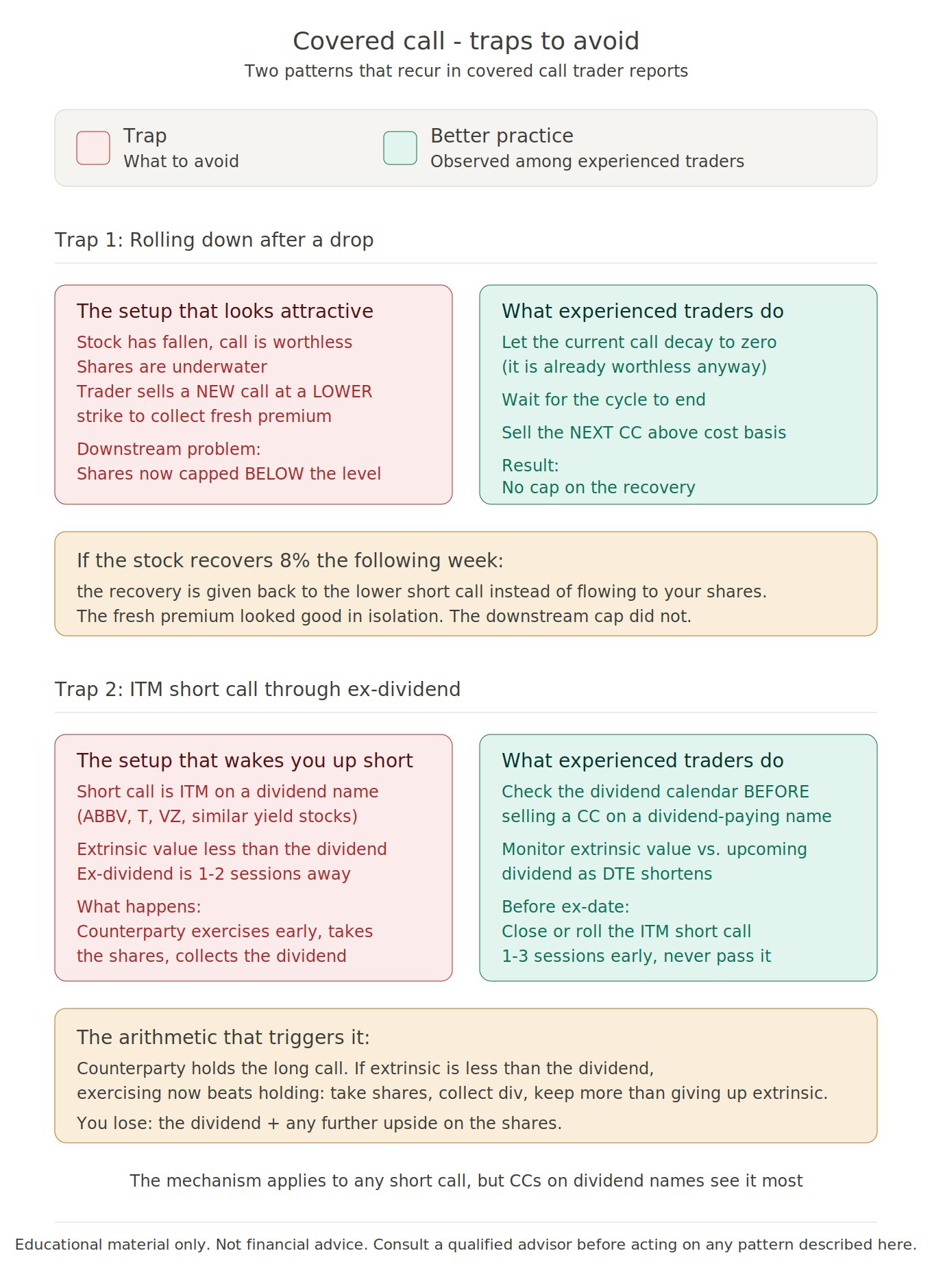
The stock falls, your old call is now worthless, and there is a temptation to sell a new one closer to the money to bring in fresh premium. It feels productive, because the cash is real and it lands in the account today.
What you have actually done is install a ceiling underneath the price your shares need to climb back to. When the bounce comes, and on a name whose story is still intact it usually does, the recovery you were waiting for gets handed to whoever bought your call. You paid for a small cheque with the exact upside you needed.
If the reason you own the shares has not changed, let the dead call expire and write the next one above your basis when the cycle resets. Patience costs less than the premium you would have collected.
Once an in-the-money short call has less extrinsic value left in it than the dividend about to be paid, the person on the other side of your trade has a free lunch available. They exercise, take your shares, collect the dividend, and keep the difference. The exercise notice arrives the day before the ex-date and you lose the dividend along with any remaining upside.
This is a hazard specific to yield names, so the higher the payout the more attention it deserves. The prevention is dull and takes half a minute: look at the dividend calendar before you open the trade, and close or roll any in-the-money call a session or two ahead of the ex-date instead of finding out the hard way.
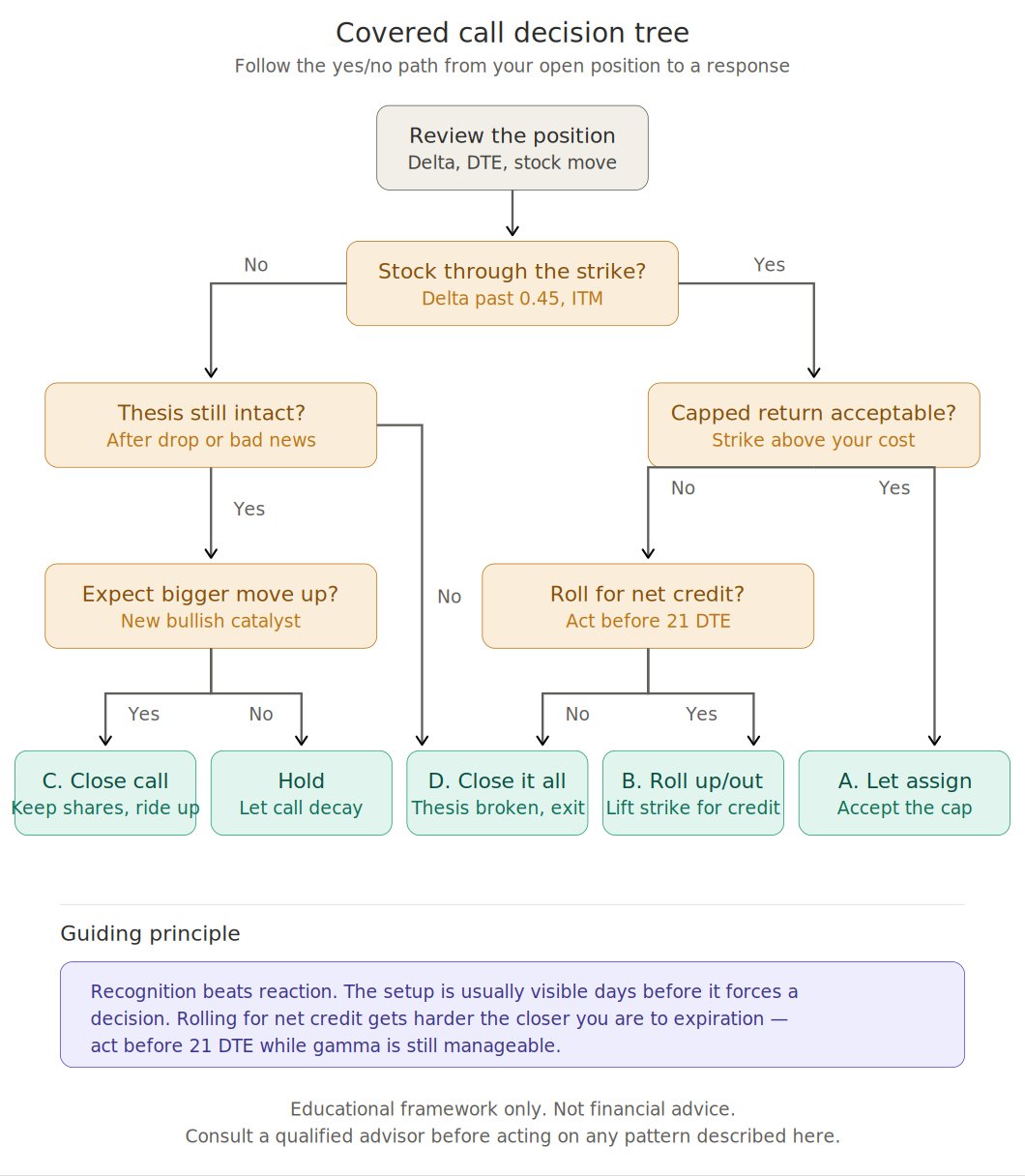
The whole thing as a flowchart
When the position is live and the screen is demanding an answer, the question is almost never "should I roll." It is whether the reason you opened the trade still holds, and if it does, whether the cap you agreed to is genuinely a bad place to sell. The chart below walks the questions in the order that keeps you honest.
If you read nothing else
Rolling a covered call is a tool, not a reflex. Before you use it, check whether the thesis you entered on still stands, whether assignment at your strike would truly be a poor outcome, and whether the chain will pay you a genuine credit to move the cap somewhere you would actually want to sell. If any of those three come back no, the roll is not the trade.
And make the decision while there is still time value in the option and the numbers are clean. Once you are inside the final week with the stock through the strike and an event on the calendar, you are not choosing anymore. The position is choosing for you.
When the alert fires, the math is already done
MyOptionDiary is the desktop wheel-strategy journal I built because I got tired of opening the option chain to do roll math under time pressure. When a covered call alert fires, four roll scenarios appear inline — close, +30 days, +45 days, and roll up for a strike improvement — each with live net credit, new delta, new breakeven, and combined P&L computed against the actual chain. The decision below is the same one this article describes. The numbers are just already on the screen.
Disclaimer. MyOptionDiary is a trade recording journal — a personal record-keeping and educational tool. It is not a trading advisory, broker, financial advisor, or investment platform, and does not provide any form of financial advice or trading recommendations.
This article describes adjustment scenarios and practitioner patterns observed among experienced options traders. It is educational material. Every position, account, and market condition is different; no single approach is universally correct. Outcomes described in worked examples are illustrative — actual results will vary.
Before making any adjustment to a live position, consider your own risk tolerance, capital, and tax situation, and consult a qualified financial advisor if you are uncertain. To the maximum extent permitted by law, MyOptionDiary and its author shall not be liable for any trading losses, financial losses, missed opportunities, tax consequences, or any direct, indirect, incidental, or consequential damages arising from your use of this article or reliance on any information, scenario, or pattern described herein. You are solely responsible for your own trading decisions and their outcomes.