How to Adjust an Iron Condor: a seven-option playbook
Your max loss is probably wrong, and the roll you want does not exist on any chain. A priced IWM condor showing why every roll to safety is a debit, and the one that turns a defined loss into an open-ended one.
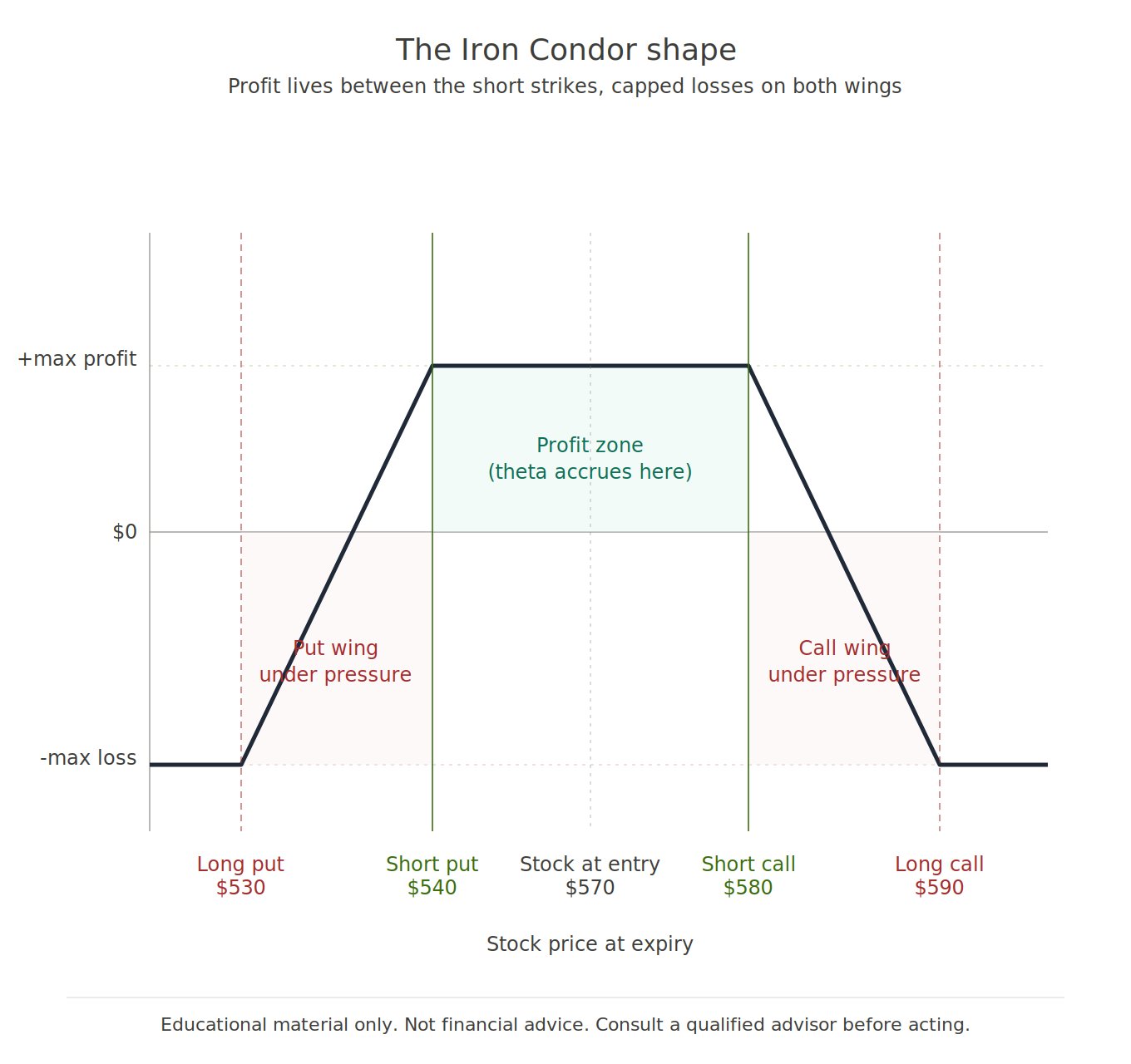
An iron condor is a bet that a stock stays in a box. When the stock leaves the box, the position starts asking you for a decision, and the decision is worse than most articles admit.
The standard advice is to roll the tested wing down and out for a credit. Price it on a real chain and you will find that the credit usually is not there. Rolling the tested wing away from the money is nearly always a debit, and understanding why that is structurally true, rather than bad luck on your particular chain, is what separates traders who manage condors from traders who feed them.
Get the risk numbers right first
Before anything else, make sure you know what you are actually risking, because this is the single most commonly botched calculation in options and it is botched in the same direction every time.
Say you sell an iron condor on IWM with the ETF at $230, 45 days out, with implied vol around 18%. You sell the $218/$213 put spread for $0.70 and the $242/$247 call spread for $0.90. Both wings are $5 wide.
| Quantity | Value | How |
|---|---|---|
| Total credit | $1.60 | $0.70 put wing + $0.90 call wing |
| Max profit | $160 | The credit, times 100. Both wings expire worthless. |
| Max loss | $340 | ($5.00 width − $1.60 total credit) × 100 |
| Breakevens | $216.40 / $243.60 | Short strike, offset by the full credit |
Max loss is the width minus the total credit, not the width minus the tested wing's credit. IWM cannot finish below $213 and above $247 on the same day. Only one wing can ever be breached, which means you keep the other wing's premium no matter what happens.
Compute it as ($5.00 − $0.70) × 100 and you get $430, and you have just overstated your risk by $90 per contract by throwing away money you are guaranteed to keep. Size a book off that number and every position you open is smaller than it needs to be. Get the sign wrong in the other direction, by counting the credit twice in max profit, and you will believe the trade pays twice what it does.
What a tested wing actually looks like
Three weeks pass. IWM has slid to $220, which is a 4.3% move, unremarkable by the standards of a small-cap index. There are 24 days left and implied vol has expanded from 18% to about 25%, because that is what vol does when equities fall.
Your short $218 put started life at 0.17 delta. It is now at 0.41. The put wing costs $1.84 to buy back. The call wing has done its job and decayed to $0.26. The position is marked at roughly $50 down against a $160 maximum profit.
Note what happened there. IWM did not breach anything. It is still above your short strike. And you are already a third of your maximum profit underwater, because vol expansion repriced the wing you are short. That is the condor's defining unpleasantness, and it arrives long before any strike is actually touched.
Now price the roll, honestly
You want to move the put wing down, away from the stock, and you want to be paid for it. Here is what the chain will actually give you against that $1.84 buyback.
| Roll the put wing to | Sell for | Net | What you got |
|---|---|---|---|
| $218/$213, 52 DTE | $2.01 | +$0.17 | A credit. And your strike has not moved an inch. |
| $218/$213, 80 DTE | $2.08 | +$0.24 | A bigger credit. Still the same strike. Now 80 days. |
| $213/$208, 52 DTE | $1.55 | −$0.29 | Down $5. You paid for it. |
| $213/$208, 80 DTE | $1.70 | −$0.14 | Down $5, out 8 weeks, and still a debit. |
| $210/$205, 80 DTE | $1.48 | −$0.36 | Down $8. The chain charges you for the room. |
There it is. Every roll that actually moves your short strike to safety is a debit. Every roll that pays you a credit leaves your strike exactly where the stock is threatening it.
This is not a quirk of this chain or this week. A lower-strike put spread is worth less premium, because it is less likely to be breached. That is the entire reason you wanted it. You cannot be paid to reduce your own risk. The only currency you can trade for a better strike is time, and even eight extra weeks does not fully cover the gap here.
So the choice in front of you is not "roll for a credit or close." It is:
- Pay a debit to move to safety. You are spending money to stay in a trade that is currently telling you it was wrong. Sometimes correct. Never free.
- Take a credit and stay in the line of fire. You have bought time and collected cash while doing nothing about the actual problem.
- Close the tested wing and keep the other one. Realize the loss on the put side, let the call spread keep decaying, and finish the cycle with a smaller loss or a scratch.
- Close the whole thing. The box you bet on is not the box the market is trading in.
Notice that two of those four are exits. On a structure this sensitive to being wrong, that ratio is about right.
Why a condor gets hard so fast
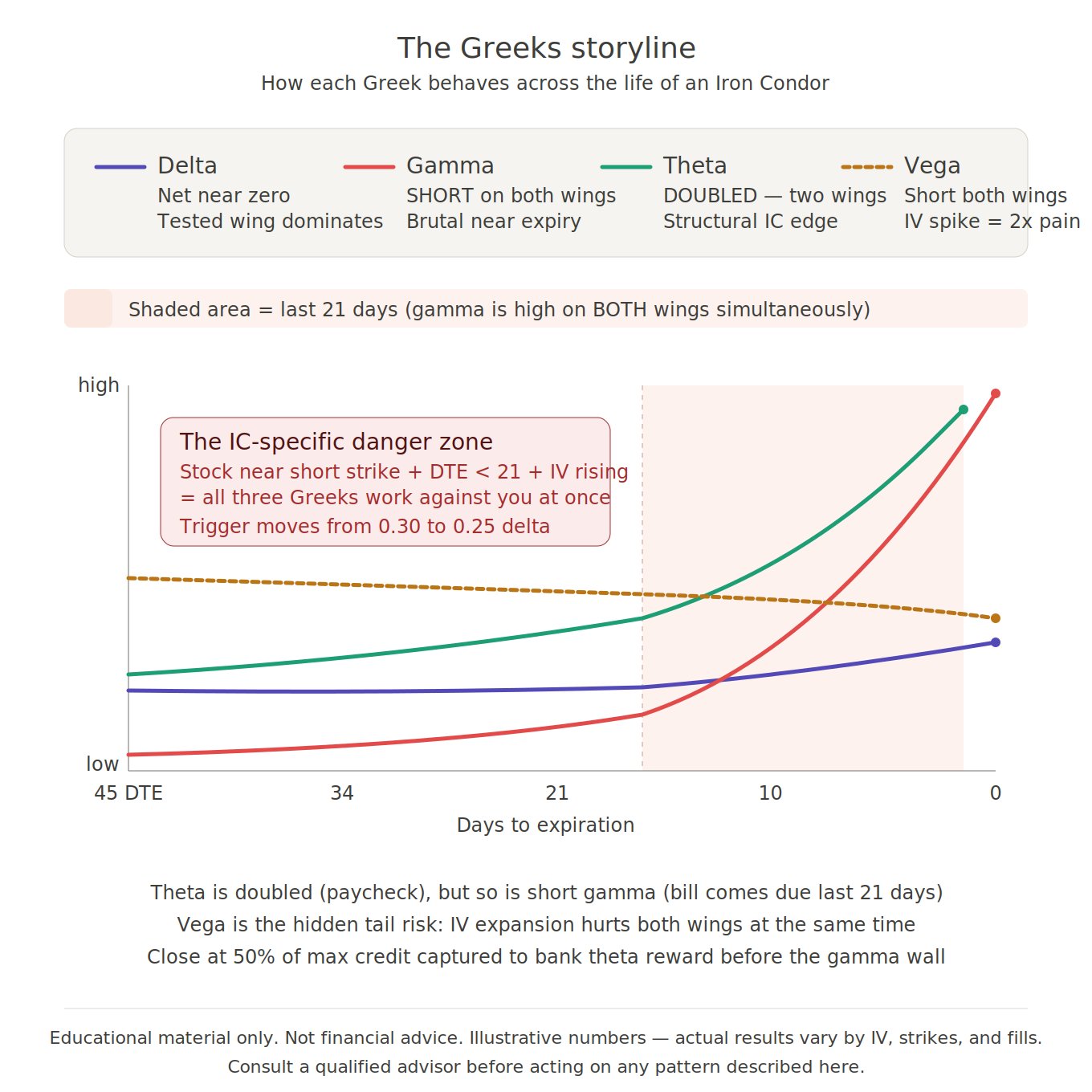
You are short volatility twice. Both wings are short vega. When implied vol expands, both wings get more expensive to close, simultaneously, and it does not matter which direction the stock went. In the IWM case above, a chunk of that $50 drawdown was pure vol expansion on a stock that had not even reached a short strike.
You are short gamma twice. The theta is doubled, which is the whole attraction, but the short gamma is doubled with it and nobody puts that in the marketing. In the last three weeks, the tested wing's delta stops behaving. A position that was fine on Friday can require a decision by Tuesday, not because anything dramatic happened, but because gamma is now large and the stock brushed a strike.
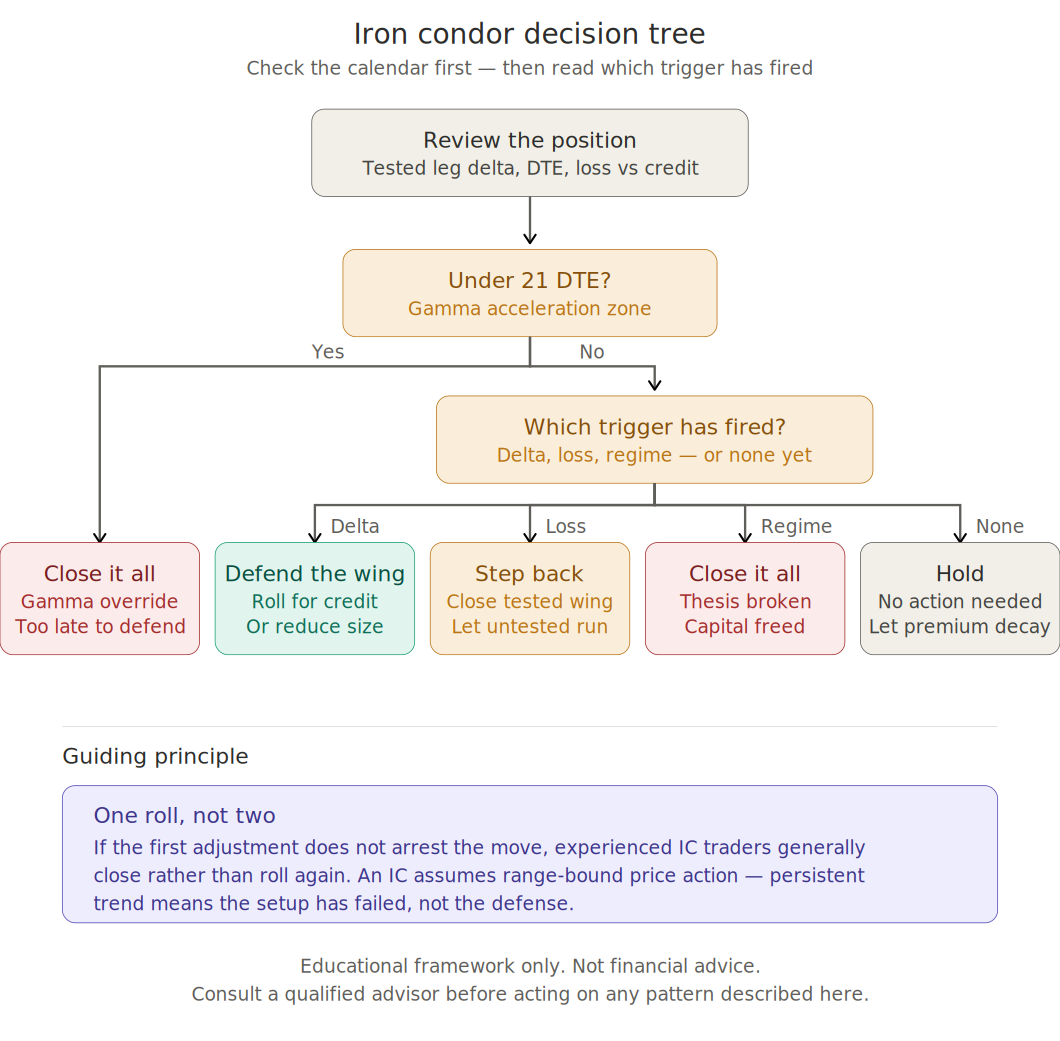
The delta that matters is not the net delta. Your position delta nets close to zero at entry and that number will keep looking reassuring long after it has stopped being informative. Ignore it. Watch the delta on the tested short leg. That is the number that tells you which wing is in trouble and how much trouble it is in. Somewhere between 0.25 and 0.35 is where most traders start taking the conversation seriously, and if vol is rising and there are fewer than 21 days left, closer to 0.25 is the honest trigger.
The short version
An iron condor makes money slowly when nothing happens and loses money quickly when something does. It collects income from two sides at once, which is nice, and it takes damage from two sides at once, which is less nice and rarely mentioned.
Two things will hurt you. The stock moving toward one of your sold strikes, and the market simply becoming more frightened, which raises the price of everything you are short even if the stock sits still. Those two tend to arrive together, because fear and falling prices are the same event.
The number to watch is not your overall position delta, which will look calm and unbothered while one wing quietly burns. Watch the delta on whichever short strike the stock is walking toward.
The chain-loss trap
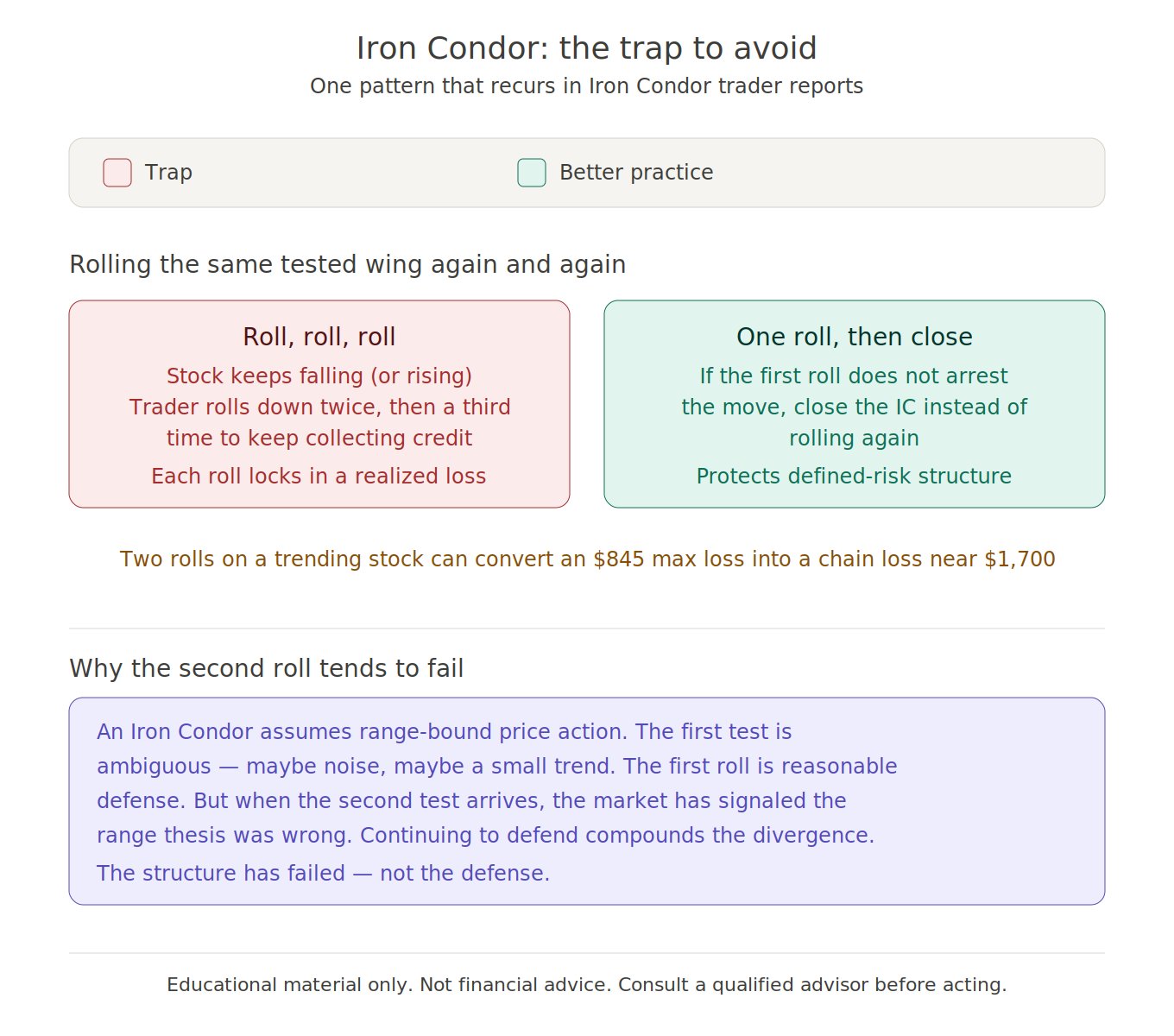
This is how a defined-risk trade stops being one. The stock moves against your put wing. You roll, paying a debit. The stock keeps going. You roll again, paying another debit. Each individual roll is defensible in isolation and each one has a defined maximum loss, which is exactly what makes the sequence so easy to walk into.
But the losses chain. Two rolls on a trending underlying can turn a $340 maximum into a realized loss approaching double that, and you are still holding the position. The defined risk was per-trade. Your account does not experience it per-trade.
The rule that saves people: the first roll is a defense, the second roll is a decision to be wrong twice. An iron condor is a bet on a range. When the market keeps telling you the range has moved, defending the old range is not risk management. It is an argument with the tape, and the tape is not listening.
The decision, as a chart
If you read nothing else
Compute your max loss as width minus total credit. Watch the tested leg's delta, not the net. And accept that the roll you want, the one that moves your short strike to safety and pays you for the privilege, does not exist on any chain in any market. You can buy safety with a debit, or you can collect a credit and keep your exposure. Any article that promises you both is selling something.
Iron Condors with the full adjustment chain on screen
MyOptionDiary supports all seven IC and IB adjustment paths through the Adj wizard — roll one leg, roll full, reduce one or both wings, roll + reduce, close one leg, close position. Every adjustment is recorded as part of the trade chain. Net credit/debit, max profit, max loss per wing, and remaining open legs are tracked automatically. The 21 DTE gamma window and tested-leg delta are surfaced as alerts before the trade enters the danger zone. The decisions in this article are the same. The math is just already on the screen.
MyOptionDiary is a trade recording journal — a personal record-keeping and educational tool. It is not a trading advisory, broker, financial advisor, or investment platform, and does not provide any form of financial advice or trading recommendations.
This guide describes adjustment scenarios and patterns drawn from active options trading. Every position, account, and market condition is different; no single approach is universally correct. Outcomes described in worked examples are illustrative — actual results will vary.
Before making any adjustment to a live position, consider your own risk tolerance, capital, and tax situation, and consult a qualified financial advisor if you are uncertain. To the maximum extent permitted by law, MyOptionDiary and its author shall not be liable for any trading losses, financial losses, missed opportunities, tax consequences, or any direct, indirect, incidental, or consequential damages arising from your use of this guide. You are solely responsible for your own trading decisions and their outcomes.