How to Adjust a Calendar Spread: a five-path defense playbook
A calendar is back-loaded by design, so it looks broken at the halfway mark. It is also long vega, which means you can be completely right about the stock and still make nothing. Both, priced on a real MSFT chain.
A calendar spread is the odd one out. It is a debit position, so you pay to open it, and yet time works in your favour. That combination is unusual enough that traders reach for it without fully understanding what they have bought.
What they have bought is a bet on two things at once: that the stock stays near the strike, and that implied volatility on the back month does not fall. The first one gets all the attention. The second one is what actually kills the position, and it can kill it while the stock does exactly what you wanted.
The structure, priced
MSFT is at $420. You sell the $420 call 30 days out and buy the $420 call 60 days out. Same strike, different expiries. Front-month vol around 22%, back-month around 23.5%, which is the normal shape of a term structure.
| Leg | Price |
|---|---|
| Sell $420 call, 30 DTE | +$11.34 |
| Buy $420 call, 60 DTE | −$17.50 |
| Net debit | −$6.16 ($616) |
The $616 debit is also your maximum loss, which is the one genuinely comfortable thing about this structure. You cannot lose more than you paid.
Why it looks broken at the halfway point
This is the most useful thing to know about calendars, and the reason so many of them get closed for no reason.
Watch what the position is worth as the front month burns down, assuming MSFT cooperates and stays near $420.
| Day | MSFT | Spread worth | P&L | Return on debit |
|---|---|---|---|---|
| 10 | $422 | $6.72 | +$57 | +9% |
| 15 (halfway) | $423 | $7.13 | +$97 | +16% |
| 22 | $421 | $8.03 | +$187 | +30% |
| 29 (front expiry) | $421 | $10.31 | +$415 | +68% |
Two thirds of the entire profit arrives in the last week. At the halfway mark, with everything going exactly to plan, you are up 16% and it feels like nothing is happening. Nothing is happening. That is the design.
The mechanism is straightforward once you see it. Time value does not decay in a straight line, it decays as a curve that steepens sharply near expiry. Your front-month short leg is racing down that steep part of the curve. Your back-month long leg is still on the gentle part. The spread between them widens fastest at the very end.
A calendar that looks flat or slightly underwater at day 15 is not a broken calendar. It is a calendar. Closing it in frustration at the midpoint means paying the debit and walking away just before the structure was going to do the only thing it does.
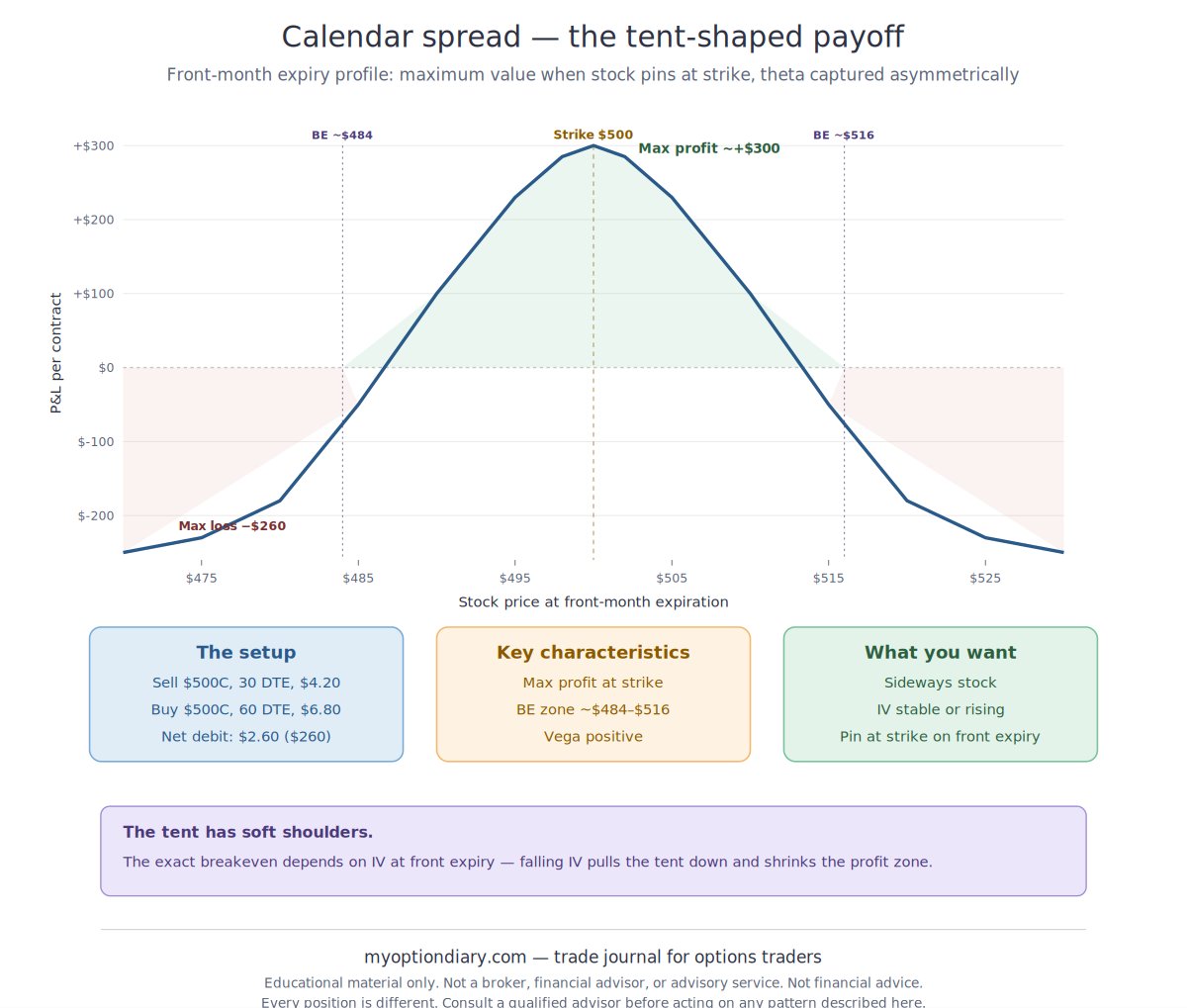
How far can the stock wander?
Less far than you think. Here is the same position at front-month expiry, across a range of MSFT prices.
| MSFT at front expiry | Move | Spread worth | P&L |
|---|---|---|---|
| $395 | −6.0% | $3.11 | −$304 |
| $405 | −3.6% | $5.79 | −$36 |
| $410 | −2.4% | $7.58 | +$142 |
| $420 | 0% | $10.31 | +$416 |
| $430 | +2.4% | $8.21 | +$206 |
| $435 | +3.6% | $6.74 | +$58 |
| $445 | +6.0% | $4.52 | −$164 |
The profitable band runs from roughly $407 to $442. Outside that, the structure loses, and it loses in both directions with equal indifference. A move of 6% either way, which MSFT can produce on a single earnings reaction, takes the trade from its maximum to a substantial loss.
Which gives you an exit rule that does not require any of the above math. If the stock is more than about 4% from the strike, the calendar is no longer doing what you bought it for. Exit. Do not wait for expiry to confirm what the distance already told you.
The trap: you can be right about the stock and still lose
Here is the one that catches people, and it is the reason calendars have a bad reputation among traders who only half understand them.
You are net long vega. You own the back month, you are short the front month, and the back month has more vega because it has more time. So a calendar makes money when implied volatility rises and loses money when it falls, independently of what the stock does.
Now suppose you opened this MSFT calendar because implied vol looked juicy. Vol was elevated. The options were expensive. That felt like a good reason to be selling the front month.
It was a terrible reason, and here is the arithmetic. MSFT pins beautifully at $421. You were completely right about the stock. But the elevated vol you entered on comes back to earth, and the back-month IV drifts from 23.5% down toward its normal level.
| Back-month IV at front expiry | Spread worth | P&L | Return on debit |
|---|---|---|---|
| 23.5% (unchanged) | $10.31 | +$415 | +68% |
| 20.0% | $8.61 | +$246 | +40% |
| 17.5% | $7.40 | +$124 | +20% |
| 15.0% | $6.19 | +$4 | +1% |
The stock pinned perfectly. You were right. And you made four dollars.
Selling premium into high IV is sound instinct on a credit spread, where you are short vega and vol compression pays you. On a calendar you are long vega. The instinct inverts completely, and traders carry it across from one structure to the other without noticing that the sign has flipped.
Enter a calendar when back-month implied vol is low or normal and you expect it to hold or rise. Entering because vol looks high means you have bought the back month at its most expensive, and vol reverting to the mean will quietly consume the profit that the stock, doing exactly what you asked, was busy earning for you.
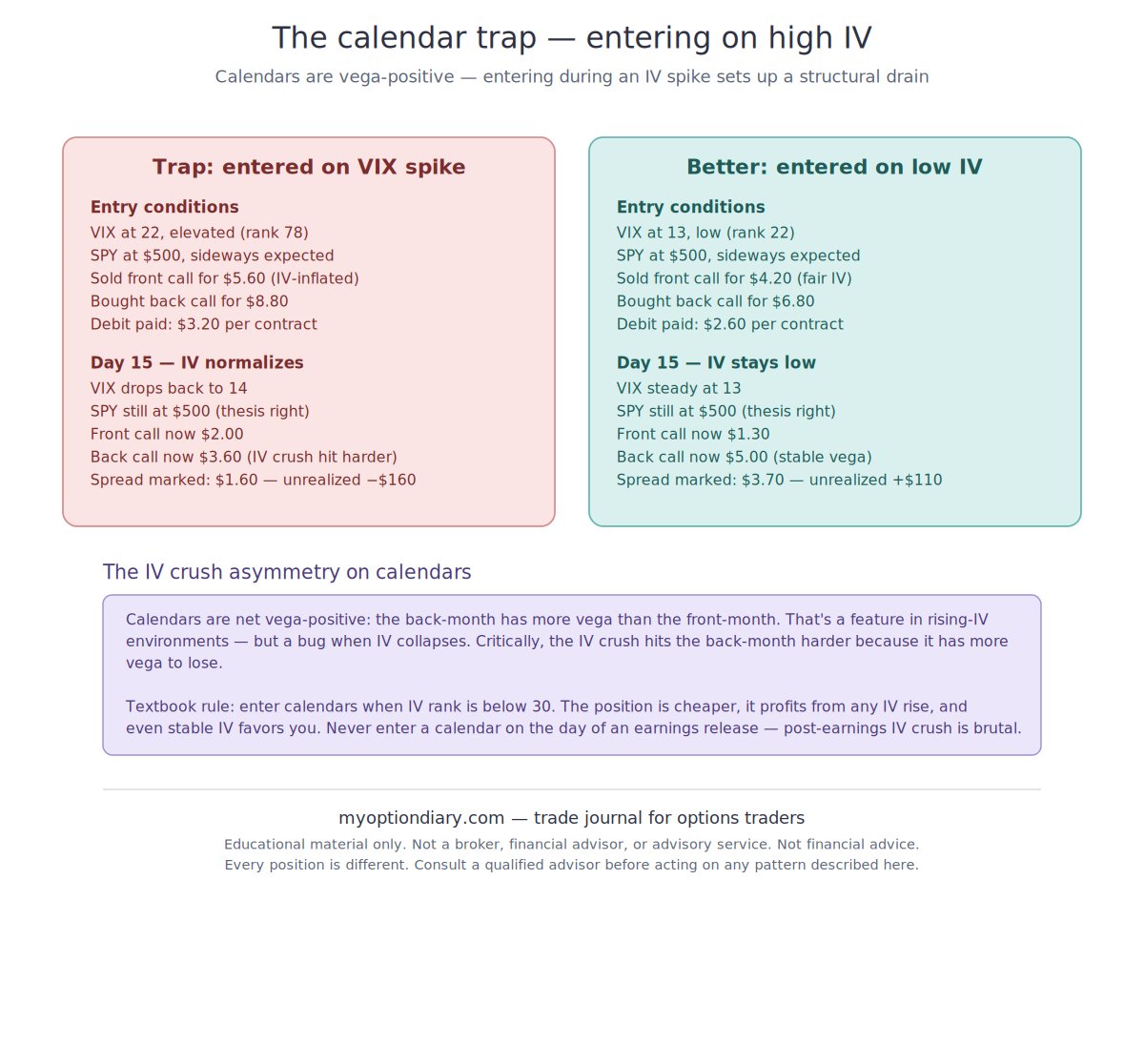
The earnings version of this is the same trap wearing a different hat. Buying a calendar with the back month spanning an earnings date and the front month expiring before it looks clever, because the back month is inflated by event premium. It is inflated for a reason. The event happens, the premium evaporates from the back month overnight, and the leg you own loses a chunk of value in a single session no matter which way the stock went.
The five things you can do
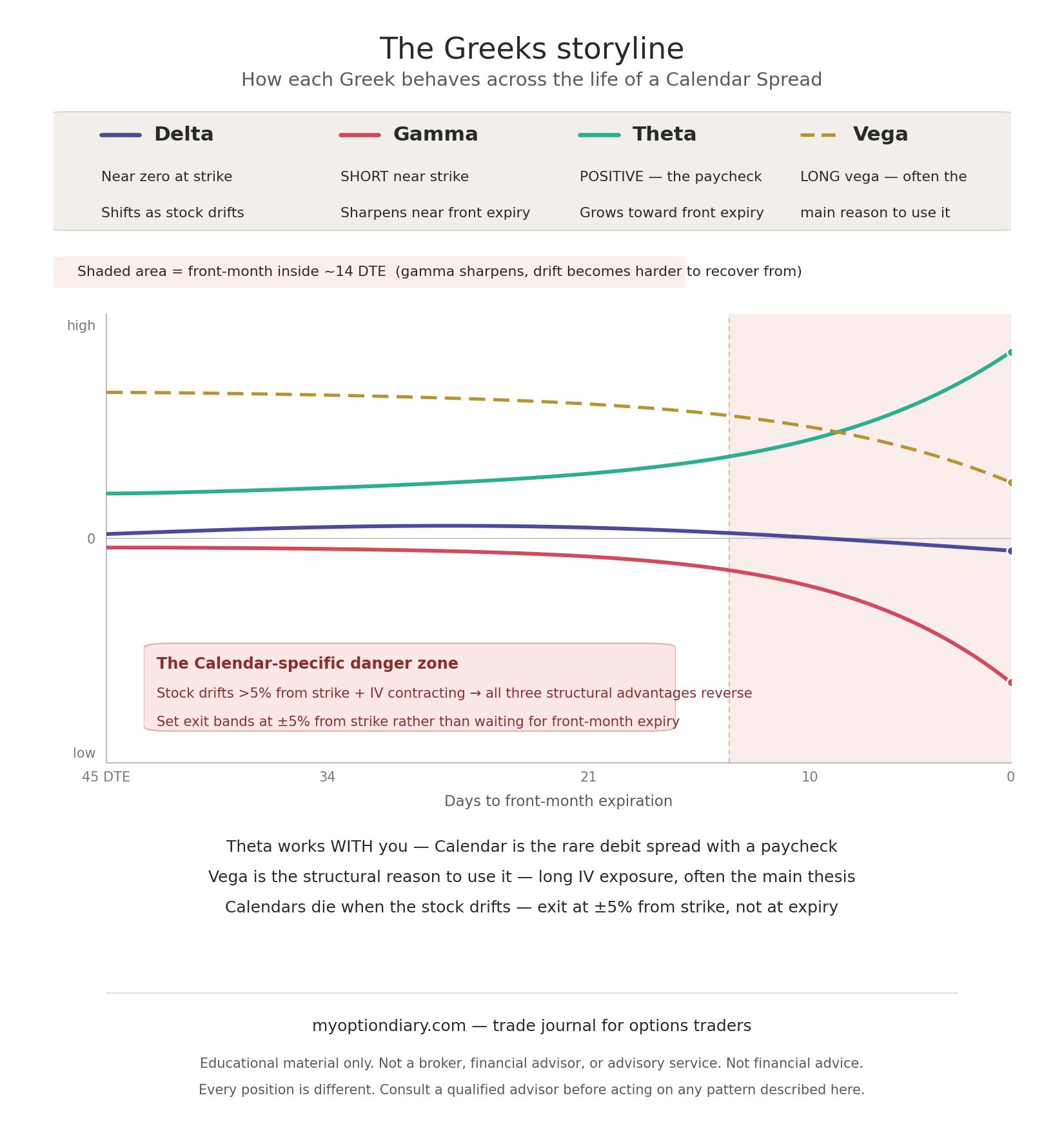
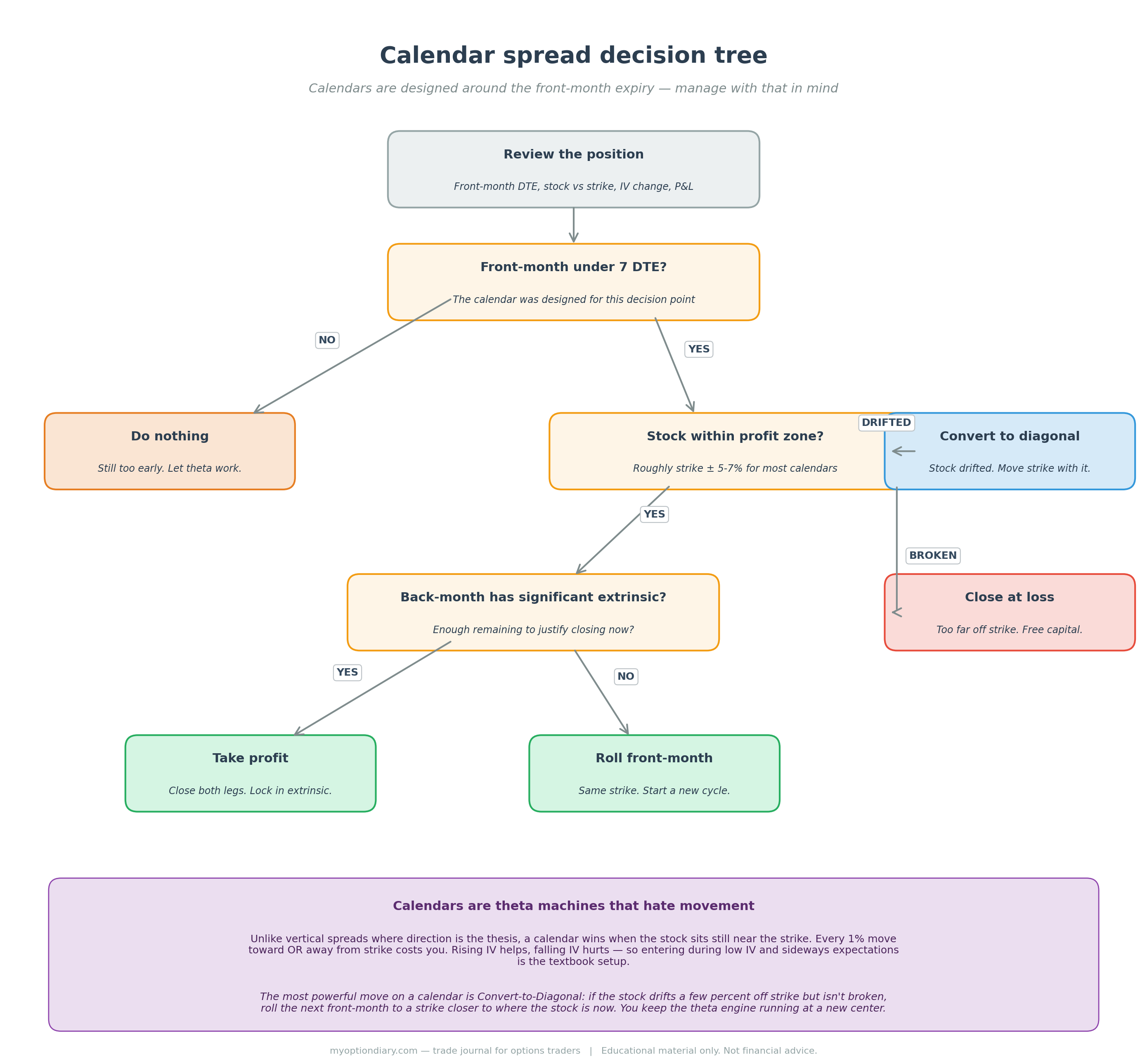
Take the profit. Close both legs. If you are near front expiry with the stock near the strike, most of what this structure can pay has already been paid. The last few days of theta are not worth the gamma risk of holding an at-the-money short into expiry.
Roll the front month. Let the short leg expire worthless, sell a new one in the next cycle against the same back-month anchor, and collect a second round of decay. This works when the stock still looks likely to sit still and vol looks stable. It is the highest-return path and it requires both of those conditions, not one.
Convert to a diagonal. The stock has drifted, so you roll the front month to a strike nearer the new price rather than the old one. Your short and long strikes no longer match, which means this is no longer a calendar. Own that. You now hold a directional position, and it should be justified on directional grounds.
Close at a loss. The stock has left the profitable band, or back-month vol has collapsed, or both. The debit is your maximum loss and you are unlikely to recover it by waiting. Take what is left.
Nothing. Genuinely on the menu, and more often correct here than in almost any other structure, because of the back-loading. If the stock is inside the band and vol is stable and you are at day 15 wondering why you are only up 16%, the answer is that it is day 15. Sit down.
The short version
You sold a short-dated option and bought a longer-dated one at the same price level. The short one loses its time value faster than the long one does, and the difference is your profit. That is the whole idea.
Two things have to hold. The stock needs to stay near the strike, within about 4%. And the market's expectation of future movement needs to not collapse, because you own the longer-dated option and its value depends on that expectation.
The second condition is the one people miss. You can be completely right about the stock going nowhere and still make almost nothing, if you bought in when options were expensive and they got cheaper while you held.
The decision, as a chart
If you read nothing else
A calendar is back-loaded by design, so judging it at the halfway point tells you nothing and closing it there costs you everything. Give it until the last week.
But give it that week only while both of its conditions hold. If the stock is more than about 4% from the strike, the structure has stopped working and no amount of patience fixes distance. And if you opened the position because implied volatility looked attractively high, understand that you were long vega the entire time and that the very thing that drew you in is now the thing working against you.
Calendar Spreads with the full adjustment chain on screen
MyOptionDiary supports all five Calendar adjustment paths through the Adj Cal wizard — roll the front-month, take profit, convert to diagonal, close at loss, or pass. Each adjustment links back to the original entry as one continuous chain. Debit paid, current MTM, cumulative credits from rolled short legs, and net P&L across the chain update automatically. The ±5% drift band, the back-month extrinsic, and the IV-rank entry gate are surfaced as alerts. The decisions described here are the same. The math is already on the screen.
MyOptionDiary is a trade recording journal — a personal record-keeping and educational tool. It is not a trading advisory, broker, financial advisor, or investment platform, and does not provide any form of financial advice or trading recommendations.
This guide describes adjustment scenarios and patterns observed among experienced options traders. It is educational material. Every position, account, and market condition is different; no single approach is universally correct. Outcomes described in worked examples are illustrative — actual results will vary.
Before making any adjustment to a live position, consider your own risk tolerance, capital, and tax situation, and consult a qualified financial advisor if you are uncertain. To the maximum extent permitted by law, MyOptionDiary and its author shall not be liable for any trading losses, financial losses, missed opportunities, tax consequences, or any direct, indirect, incidental, or consequential damages arising from your use of this guide. You are solely responsible for your own trading decisions and their outcomes.